Material provenance and sustainable sourcing
We invest significant effort into the traceability of materials: our partnerships with regional mills and reclamation yards mean that timber is selected for quality, stability and ethical sourcing. Rather than choosing the least expensive stock, we evaluate drying history, grain clarity and presence of natural defects that can be celebrated in design. For projects requiring minimal new timber we employ reclaimed components that are re-milled and matched to new elements; this reduces embodied carbon and enriches a piece with layered history. In addition to wood sourcing, we select non-toxic finishes and hard-wearing adhesives that support indoor air quality while ensuring longevity. The result: furniture that is not only beautiful at first sight but that also offers predictable dimensional stability and the capacity to be repaired rather than discarded, reinforcing a circular approach to material use.
Traditional joinery fused with modern precision
Our structural approach blends centuries-old joinery techniques with contemporary accuracy. Mortise-and-tenon, dovetail and housed joint strategies are applied where movement, load and longevity demand them, while CNC-assisted milling and jigs ensure repeatability and tight tolerances. This hybrid method preserves the tactile character of handmade connections while eliminating fit issues common in hand-only production. Components are test-fitted, adjusted and often left to acclimatize prior to final assembly to minimize stress and movement over seasons. With this method, end-users experience stable joints, reduced squeaks or loosening, and an overall resilience that stands up to daily use across decades.
Design for repairability and lifecycle value
One of our guiding principles is that furniture should be serviceable: fasteners are chosen for accessibility, wear surfaces are replaceable and finishes are applied in a way that allows localized repair. Rather than concealed permanent glues and inaccessible assemblies, we favor mechanical fixes that enable re-finishing or component replacement without destroying a piece. This design-for-repair ethos increases lifecycle value and aligns ownership with stewardship—clients seldom need to replace whole pieces because worn elements can be renewed. We provide care guides and offer service appointments for refinish, stabilization and modifications, ensuring that significant investments remain relevant to evolving interiors.
Prototype-driven collaboration and transparent process
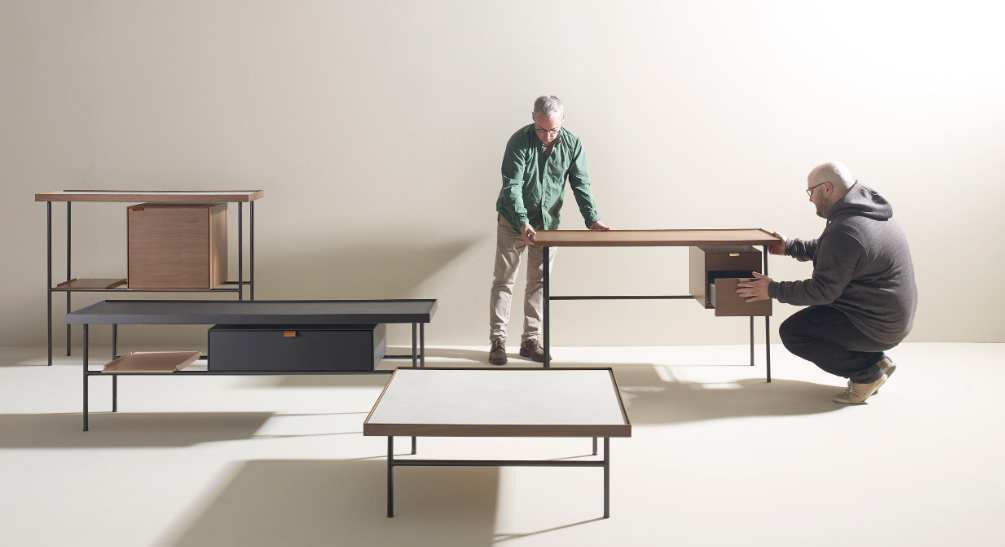
For bespoke commissions we follow a transparent process: initial sketches, detailed CAD views, sample joints and finish swatches, followed by a full-scale mockup when appropriate. This prototype-first philosophy reduces surprises at delivery and deepens client confidence in material and scale decisions. Communication is structured via checkpoints where adjustments are logged and approvals recorded. We also maintain clear timelines and openly discuss constraints—such as lead times for specific timbers—so clients can plan installations and budgets with certainty. The studio environment is collaborative, welcoming interior designers to review mockups and participate in final aesthetic decisions.
Small-batch production with consistent quality control
Working in small batches allows us to keep exceptional attention on each item without the compromises typical of mass production. Each batch follows documented quality-control checks: dimensional verification, joint fitting audit and finish inspection. This model also permits subtle iterations—slight refinements that improve ergonomics and surface uniformity—without impacting delivery timelines. Clients buying a limited series receive matching aesthetic standards across pieces while still benefiting from the craftsmanship associated with hand-finished work.
Tailored finishes and surface engineering
Our finishing suite ranges from hand-rubbed oils that accentuate grain to durable catalyzed finishes for high-traffic surfaces. Finish choices are selected to balance look, tactile quality and lifespan: porous oil systems that allow easy spot repair, or more resilient multi-layer coatings for tabletops and kitchen surfaces. We also apply specialty techniques like tinted oils, inlay accents and metal patinas to complement design language. Before full finishing we apply test panels so clients understand the final effect under different lighting and use conditions. The outcome is an ensemble of surfaces engineered to match the intended function of each piece while maintaining aesthetic coherence across a collection.